
Calendering doesn’t fail all at once. It drifts until variation, scrap, and downtime start stacking up.
A plant may begin with minor thickness variation across the web. Operators adjust nip pressure or temperature. The line stabilizes briefly, then drifts again. Over time, the process depends on constant intervention. What appears to be a process issue is often mechanical.
In tire manufacturing, calendering is a precision-dependent operation. Rolls, shafts, and tooling define the limits of thickness control and material distribution. As production speeds increase, those limits narrow. Small geometric deviations that were once manageable scale into instability, scrap, and downtime.
Where Instability Begins
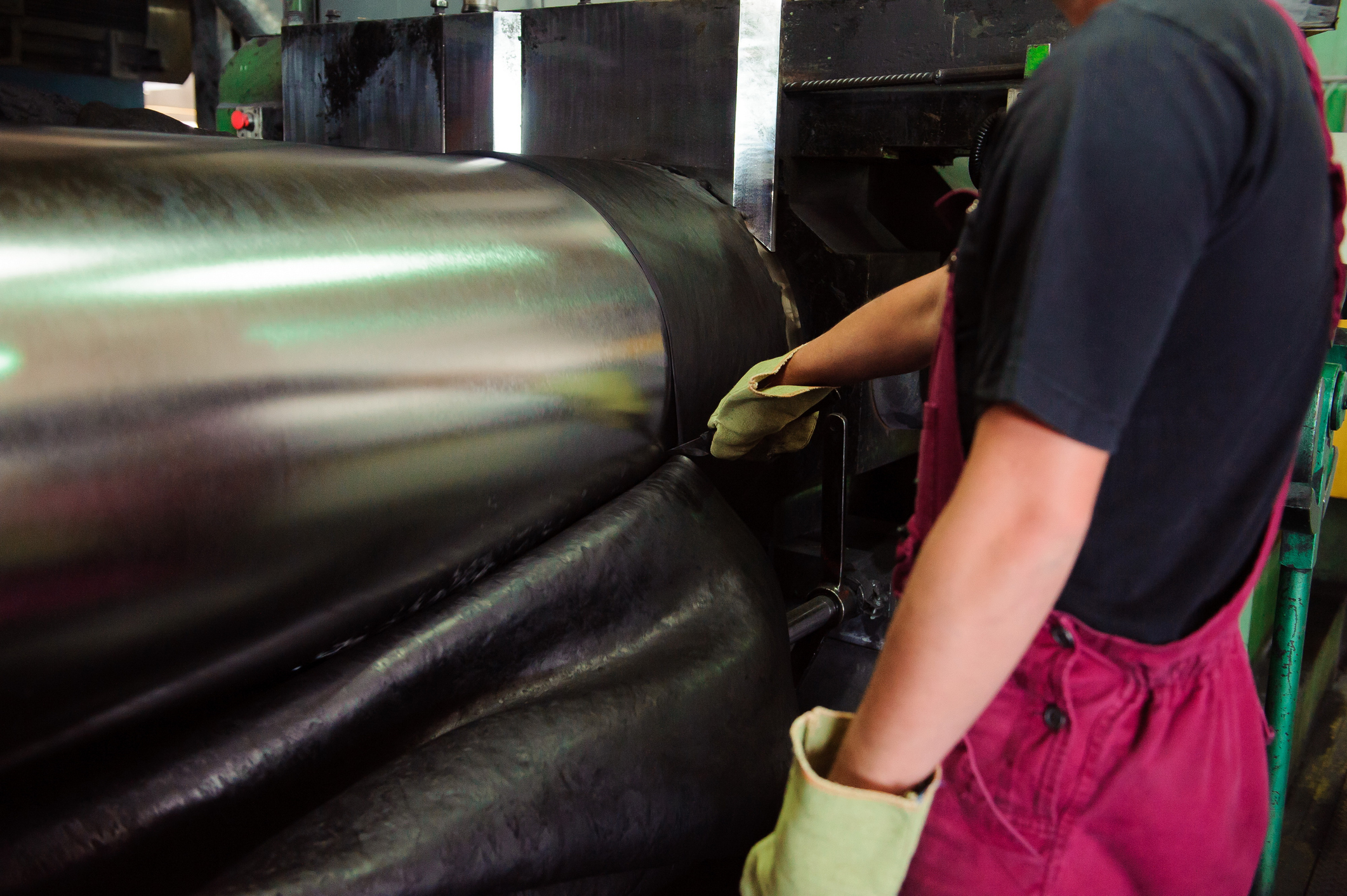
Instability is often treated as a process problem because that is where it becomes visible. Operators see variation in output, not the condition of the components behind it. Adjustments are made repeatedly while the source remains unchanged.
To break that cycle, symptoms need to be traced back to physical causes. Inconsistent output usually reflects how components have degraded over time. The connection between component condition and process behavior is consistent, even when it is not obvious.
How Mechanical Deviation Shows Up In Production
Mechanical deviation follows recognizable patterns tied to specific components. Once those patterns are understood, it becomes easier to determine whether a problem can be tuned out or must be physically corrected.
- Roll profile wear creates persistent thickness variation.
As rolls wear, surface geometry changes across the face. This leads to uneven pressure in the nip, producing thick and thin zones that process settings cannot fully correct. Operators compensate more aggressively, but the variation returns.
- Runout and eccentricity create repeating defects.
A roll that is no longer perfectly round or aligned generates periodic variation. This shows up as repeating patterns in thickness measurements. Control systems respond, but always reactively, creating oscillation rather than stability.
- Shaft misalignment disrupts system stability.
Misaligned shafts affect tracking, tension, and load distribution. The effect extends beyond thickness variation, leading to wrinkles, vibration, and accelerated wear on adjacent components.
| Component Condition | Observable Symptom | Operational Impact |
| Roll wear | Cross-direction variation | Scrap, rework, inconsistency |
| Runout | Cyclic defects | Control instability |
| Misalignment | Tracking issues | System-wide wear and vibration |
Correcting these issues requires restoring geometry, not adjusting parameters. That work typically depends on precision machining.
Why Wear Becomes A Production Constraint
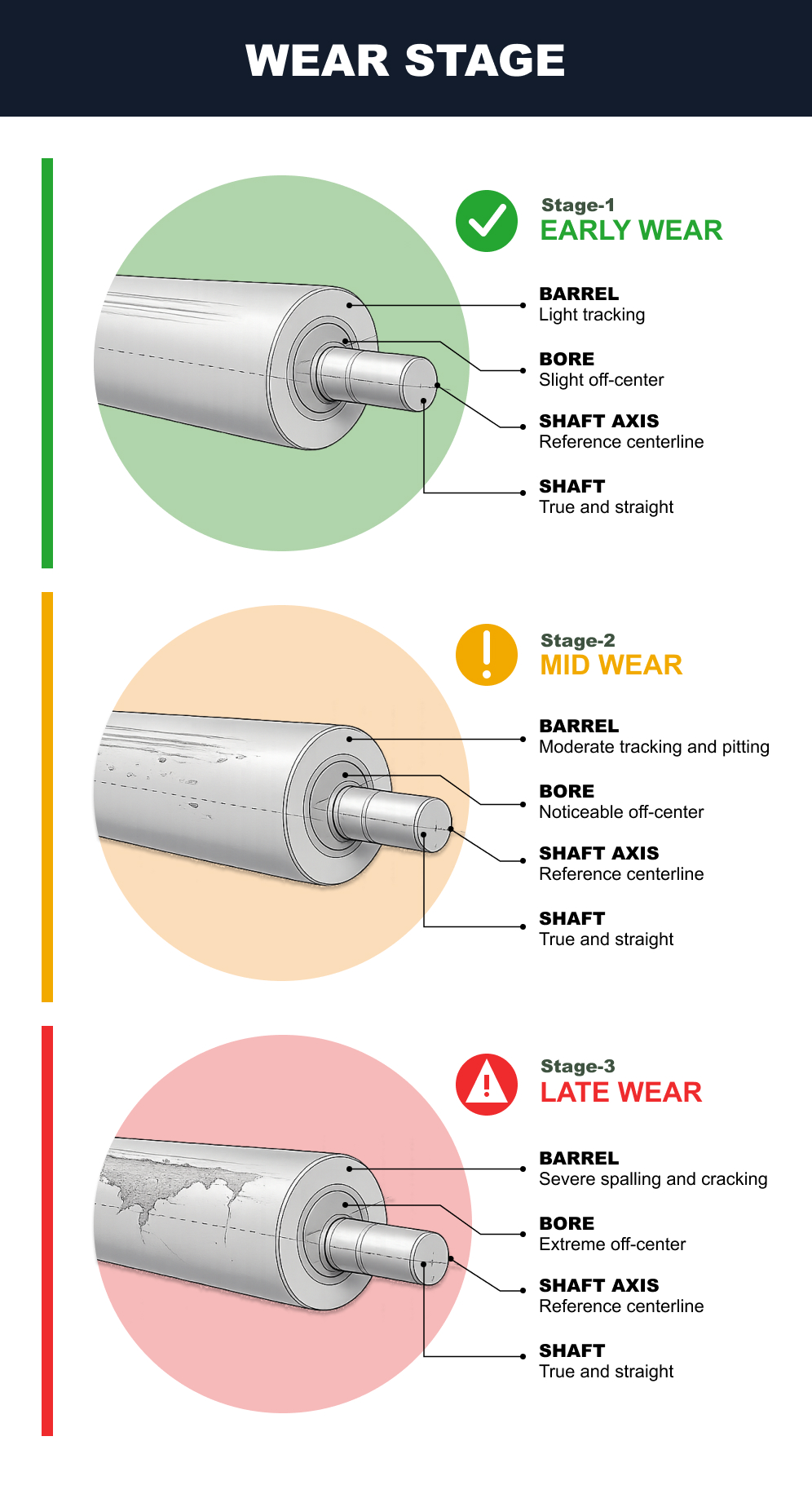
Tooling wear develops continuously, while maintenance remains periodic or reactive.
This mismatch lets variability grow unchecked.
As production speeds increase, the cost of that gap rises.
The faster the line runs, the more quickly small deviations translate into material loss.
The question is not whether wear exists, but how early it’s addressed.
How Roll Wear Escalates From Drift to Downtime
Wear follows a progression you can see in production behavior. Understanding that progression explains why delayed action leads to disproportionate consequences.
| Early Wear | Mid Wear | Late Wear | |
| Plant Sees | Minor drift | Inconsistent output | Out-of-spec product |
| Reality | Geometry beginning to change | Wear affecting distribution | Mechanical limits exceeded |
| Visual Cue | Subtle color shift or thin highlight line showing deviation starting | Variability bands widening; output icons no longer uniform | Hard red boundary line, component silhouette exceeding tolerance |
A common scenario reflects this pattern. Early roll wear is detected but replacement is delayed due to machining lead times. Production continues under adjusted conditions until variability escalates into scrap and eventual stoppage.
When Replacement Does Not Restore Stability
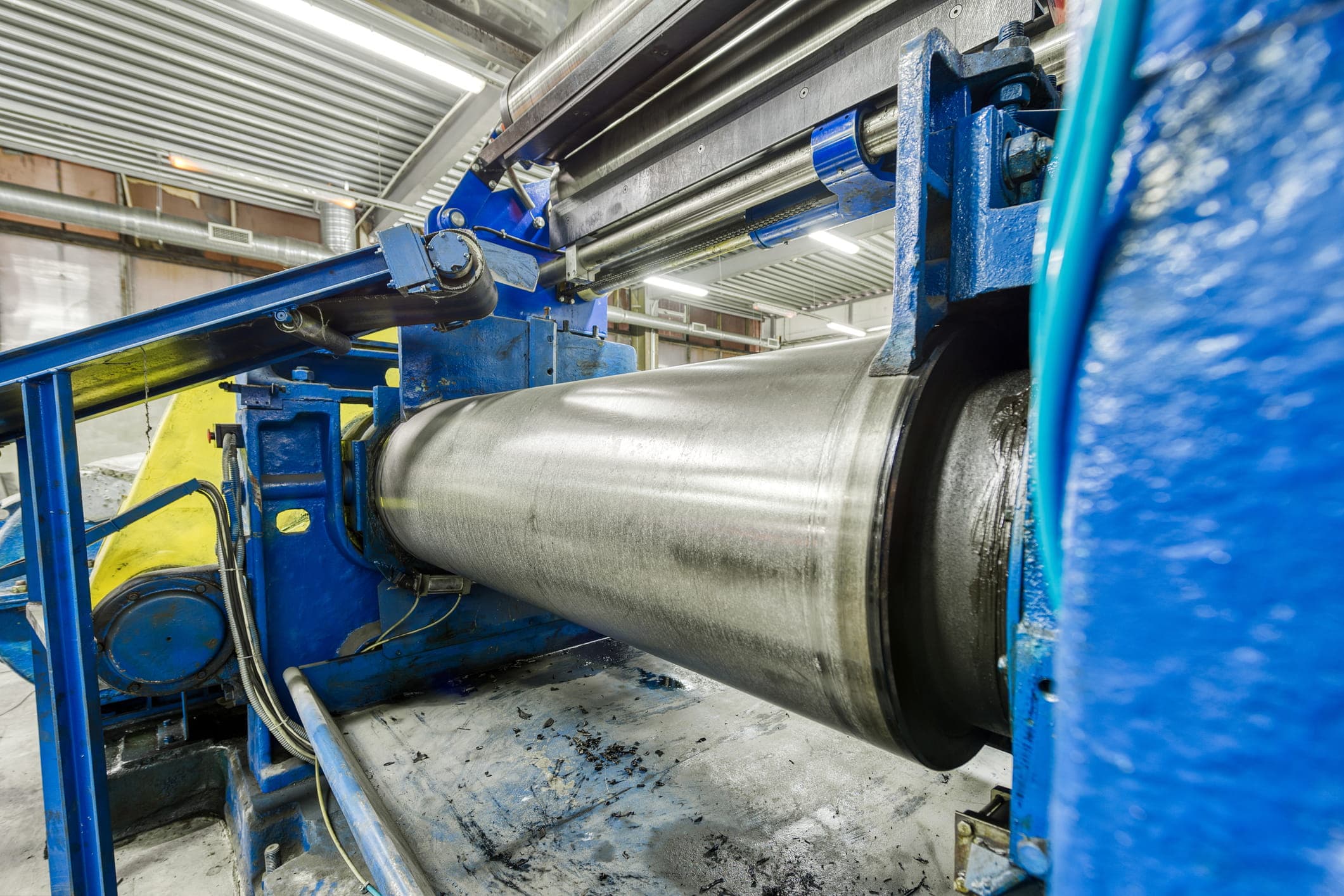
Maintenance cycles are often built around replacement. The assumption is that replacing a component restores baseline performance. That depends on how accurately the component is restored.
The gap between replacement and restoration is where recurring issues begin. A component can meet specifications on paper but behave differently under load. At higher speeds, those differences start to matter in production.
What Determines Whether A Repair Actually Works
Understanding repair outcomes requires looking beyond dimensions to how a component behaves in operation.
- Surface finish influences material behavior.
Rubber interaction with the roll surface depends on finish quality. Variations affect adhesion, flow, and release, introducing subtle but persistent defects.
- Concentricity affects dynamic stability.
Even slight deviations create vibration under load, disrupting the process and accelerating wear in surrounding components.
- Tolerance repeatability defines long-term stability.
Reliably reproducing the same geometry across repair cycles determines whether the process stabilizes or continues to drift.
That’s where precision machining is important. It ensures that geometry holds from one cycle to the next.
The Limits of Automation Without Mechanical Stability
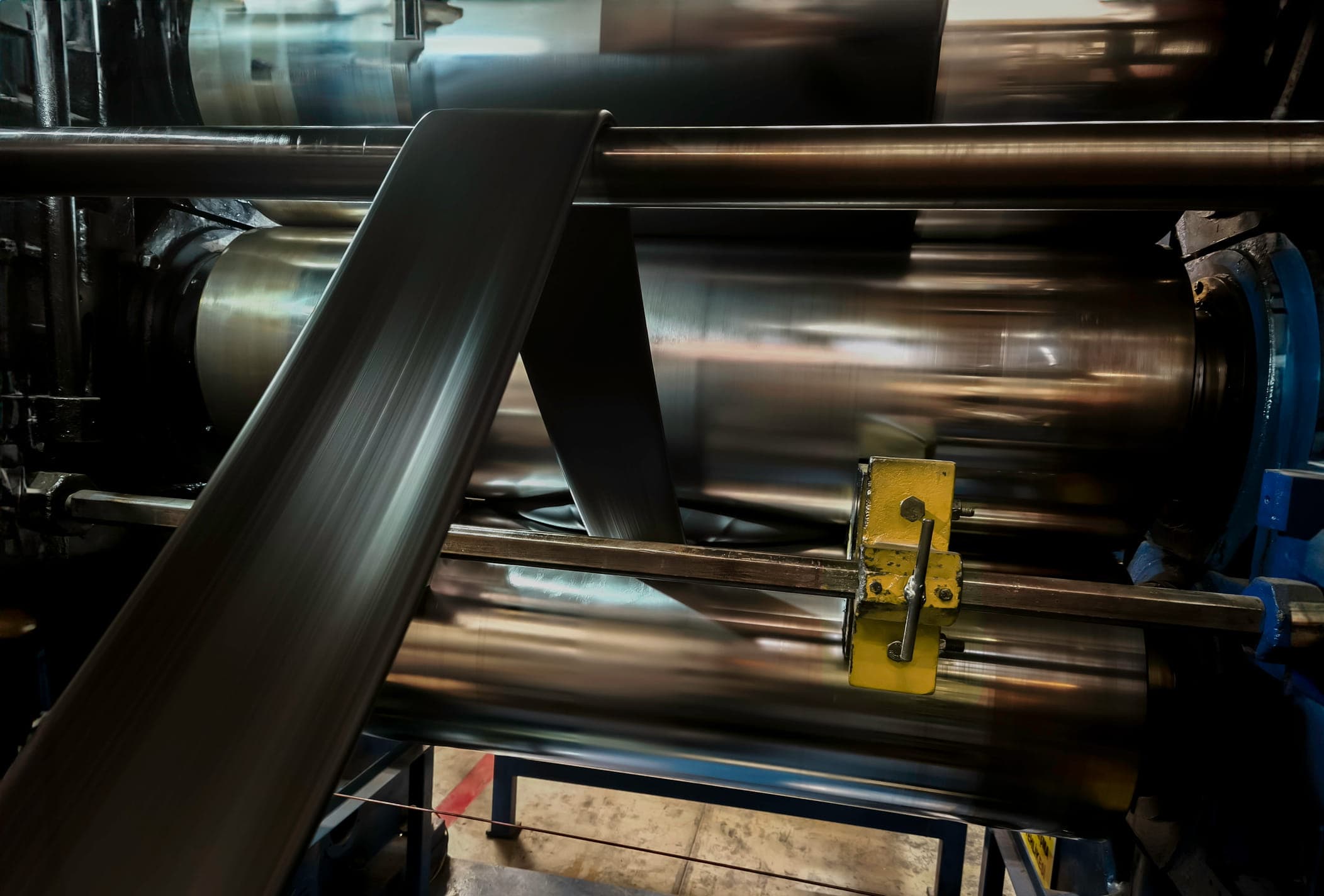
Automation and inline inspection systems are increasingly used to monitor calendering performance.
They provide continuous data on thickness, profile, and balance.
This visibility is valuable, but it has limits.
The main distinction is between detecting a problem and resolving it. Automation handles the first. The second depends on stable conditions.
Why Automation Depends On Stable Inputs
Automation systems rely on consistency to function effectively. When that consistency breaks down, they move from stabilizing the process to reacting to it.
- Detection without correction leads to constant alerts.
When mechanical conditions are unstable, inspection systems repeatedly flag defects. The plant gains visibility but not resolution.
- Control systems can’t stabilize unstable inputs.
Automated adjustments rely on consistent conditions. When those fluctuate, systems keep reacting without ever settling.
- Measurement accuracy depends on stable geometry.
Reliable data requires a stable reference. Without it, measurements reflect noise rather than usable trends.
| System Behavior | Unstable Mechanics | Stable Mechanics |
| Inspection | Repeated defect signals | Early deviation detection |
| Control | Constant correction | Stable adjustment |
| Output | Persistent variability | Consistent production |
Stabilizing Legacy Lines Without Replacing Them
Most tire manufacturers operate calendering systems that were not designed for current throughput demands. Replacing these systems entirely is often impractical. Stability improvements instead come from targeted upgrades.
These upgrades work best when they focus on the components that define process behavior. Instead of replacing the system, plants adjust the inputs that prompt its performance.
How Plants Improve Stability In Existing Systems
Stability improvements typically follow an incremental upgrade pattern concentrated on the main sources of variation.
- Precision-machined roll upgrades improve baseline performance.
Reground or newly manufactured rolls with tighter tolerances reduce inherent variation, allowing the process to run within a narrower, more stable window.
- Shaft restoration reduces vibration and misalignment.
Correcting alignment and concentricity stabilizes load distribution, improving both product quality and component life.
- Inline inspection adds real-time visibility.
Measurement systems enable earlier detection of drift, reducing defect scale before intervention.
A typical example involves a legacy line with ongoing variation. Replacing worn rolls with precision-ground components and adding inline measurement stabilizes output without major capital investment.
The Missing Layer Between Process and Performance
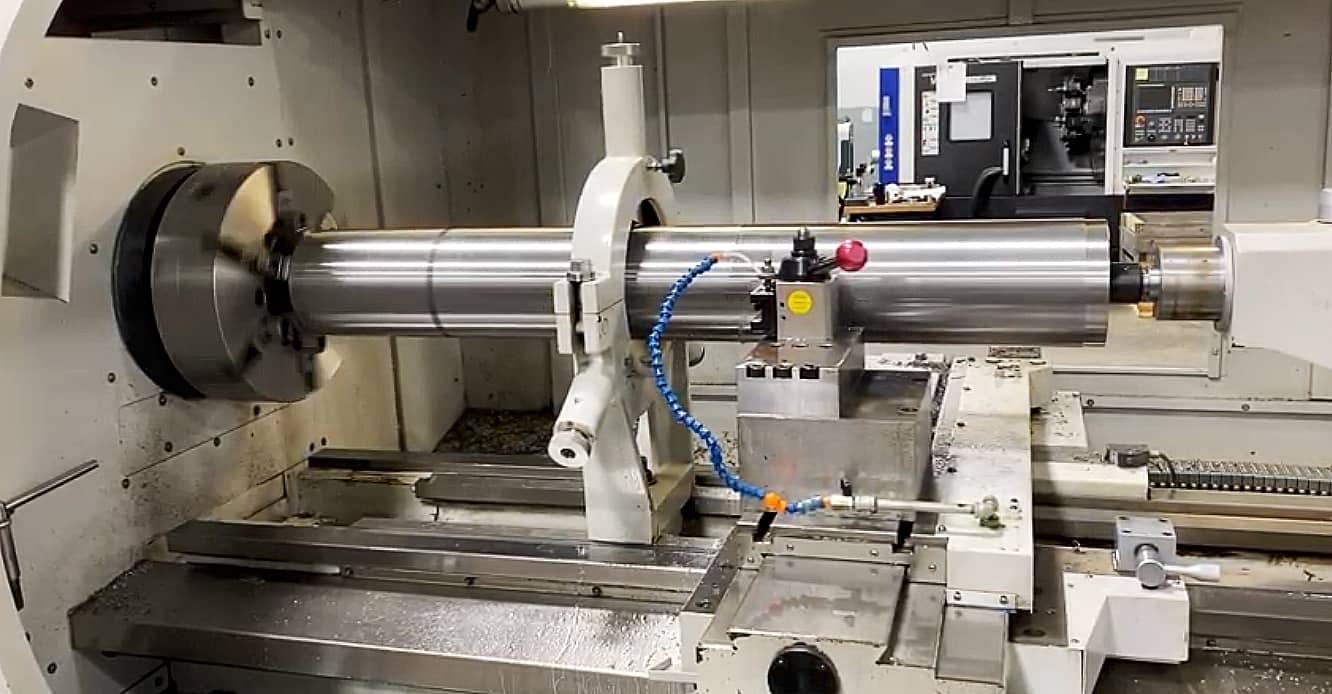
Most discussions around calendering performance stay inside the machine. They focus on equipment capability, process parameters, and increasingly, automation systems. These are visible, measurable, and within the plant’s control.
What’s less discussed is the layer that sustains those systems over time. Mechanical precision doesn’t hold on its own. It degrades, and restoring it depends on external capability. That dependency is often treated as support rather than as part of production stability.
Where Industry Focus Tends To Stay
Conversations are weighted toward elements that are easier to measure and optimize within the plant.
- Machines are evaluated based on capability and specification.
Discussions center on speed, pressure range, and configuration. These assume the machine continues to operate within its original tolerances.
- Process parameters are treated as primary control levers.
Adjustments to temperature, nip force, and speed are used to manage variation. This reinforces the idea that stability is a process issue, even when mechanical drift is the cause.
- Automation is positioned for efficiency and visibility.
Investments are often justified through labor reduction or monitoring. Their role in stabilizing variation is acknowledged, but not always tied back to mechanical precision.
What Is Consistently Overlooked
The missing layer is operational. It sits between maintenance and production.
- The machining ecosystem that sustains precision over time.
Rolls, shafts, and tooling do not stay within tolerance indefinitely. Their performance depends on how accurately they are restored. This restoration is often external, making machining capability part of the production system.
- The role of external partners in uptime continuity.
When a critical component degrades, the speed and quality of external response determine whether the issue becomes downtime. That makes machining partners a direct contributor to uptime.
Calendering performance depends on maintaining the mechanical conditions required for stability.
Quality Planning
Strengthen inspection accuracy and compliance with disciplined, traceable quality processes from the start.
Let’s Discuss Your Requirements
Implications for Tire Manufacturers
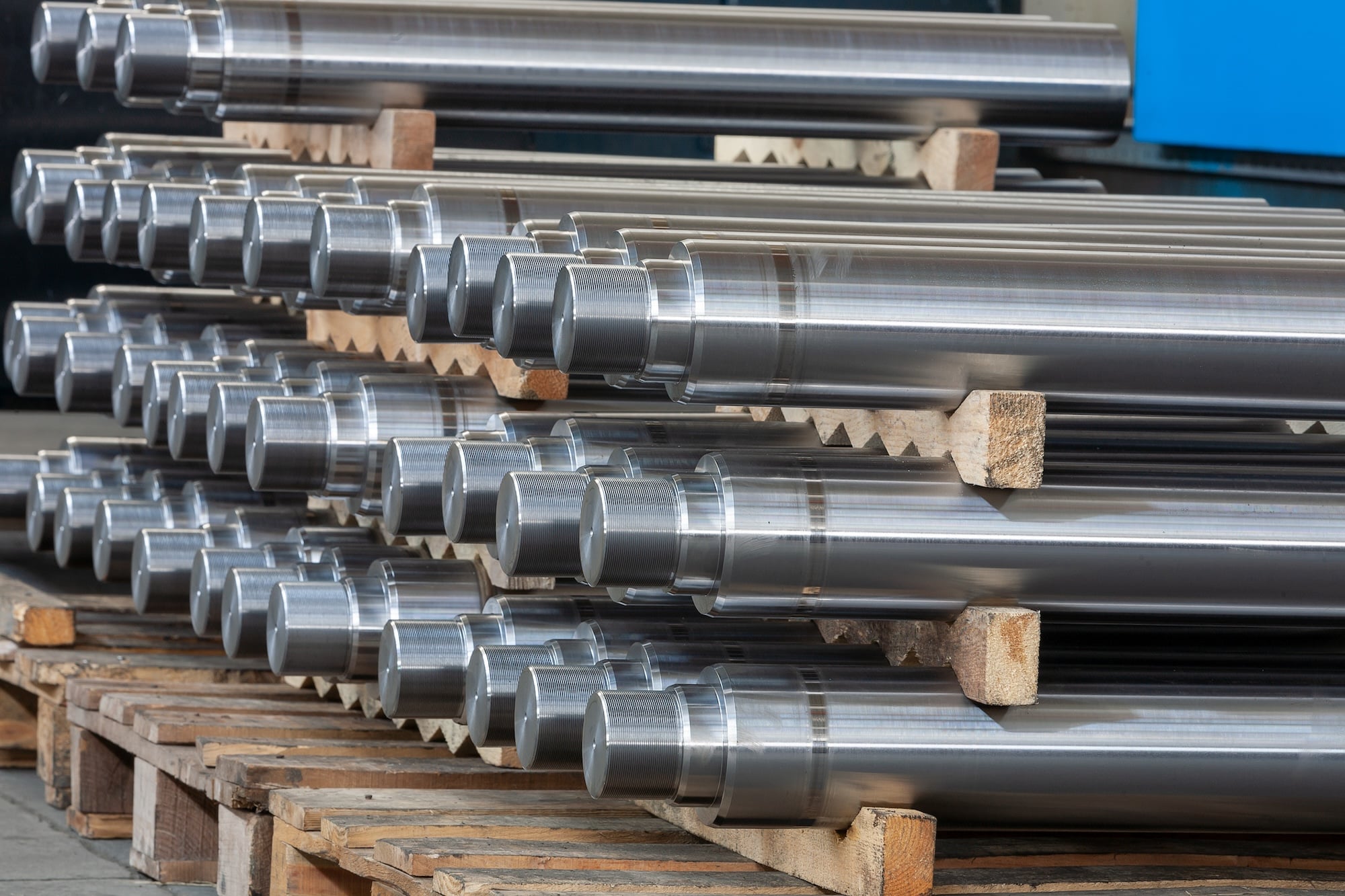
Recognizing this dependency changes how calendering is managed. It shifts focus from isolated process control to system-level coordination.
The implications extend across operations, engineering, and procurement.
Operational Implications
From an operations standpoint, uptime is no longer determined only by how well the line is run. It also depends on how quickly and accurately the line can be restored when components degrade.
- Uptime depends as much on restoration speed as it does on failure detection.
Identifying a worn roll early has limited value if refurbishment cannot be completed within a useful timeframe.
- External machining becomes part of the production system.
Plants increasingly rely on machining partners as an extension of their internal capability, shifting from reactive sourcing to proactive coordination.
Technical Implications
From an engineering perspective, tolerances move from static specifications to requirements that must be maintained over time.
- Tolerances must be clearly defined at the application level. It’s not enough to specify dimensions.
Engineers must define how those dimensions translate into process behavior, including acceptable variation under load.
- They must also be maintained through lifecycle management.
Wear, repair, and replacement all affect how tolerances evolve. Managing this lifecycle becomes part of process control.
- And reproduced consistently across cycles.
Each repair or replacement must return the component to the same condition. Variability between cycles introduces instability even when individual components meet spec.
Organizational Implications
Managing calendering as a system requires coordination across functions that traditionally operate separately.
- Operations, maintenance, and procurement must align on priorities.
Decisions about when to replace components, where to source them, and how quickly they must be delivered are interconnected. Misalignment leads to delays and instability.
- External machining partners must be integrated into planning.
Instead of being engaged only during failure, machining providers need to be part of scheduled maintenance and improvement strategies.
Risk Implications
When the machining layer is weak or inconsistent, the consequences are cumulative.
- Recurring failures become more likely
- Downtime extends beyond the initial failure event
- Output becomes inconsistent over time
What Good Looks Like
Plants that maintain calendering stability treat precision as an ongoing requirement. Their approach reflects a system-level understanding of how components, processes, and external partners interact.
Maturity Indicators
Stable operations are not defined by the absence of wear or failure, but by how predictably those events are managed.
- Predictable component lifecycle management.
Wear patterns are understood, and replacement or refurbishment is scheduled before variability escalates. Maintenance becomes planned rather than reactive.
- Minimal variability after replacement or repair.
Components behave consistently when reinstalled. The process returns to baseline without requiring extensive adjustment.
- Reduced dependency on emergency fixes.
Because issues are addressed earlier and more predictably, unplanned interventions become less frequent.
What To Look For In A Machining Partner
Selecting the right machining partner, like PMi2 becomes a strategic decision rather than a transactional one.
- Proven ability to hold tight tolerances
- Fast and reliable turnaround times
- Experience with roll and shaft applications
Capability to support both repair and new manufacturing
Early Warning Signs Of Instability
Instability often appears before it becomes disruptive. Recognizing early signals allows intervention before the impact scales.
- Increasing variability after component replacement
This suggests replacements are not restoring the system to its original condition
- Long delays in repair cycles
Extended turnaround times increase the likelihood that wear progresses into failure
- Inconsistent performance across similar components
Variability indicates a lack of repeatability in manufacturing or restoration
Stability Is a System Outcome
Calendering stability is not determined by a single factor. It emerges from the interaction between mechanical precision, tooling condition, inspection capability, and the ability to restore components quickly and accurately.
Plants that treat these elements as interconnected experience fewer disruptions and more predictable output. Those who rely primarily on process adjustment often end up managing recurring instability.
The shift underway is toward managing calendering as a system supported by precision machining and automation. Companies like PMi2 operate within this model, helping manufacturers maintain the conditions required for stable, high-throughput production.
Roll & Shaft Fabrication
Extend roll life with precise machining, verified hardness, and complete production traceability.
Save Time, Lower Costs