Skip to content

Remove System Constraints

Workflow Chokes CNC Output

Your machines can run harder than the current workflow allows. Labor‑dependent steps slow production long before the equipment reaches its limits.

  • Shops can’t hire or keep enough machinists
  • Spindle time disappears between cycles
  • Setups stop cutting and consume hours
  • Manual assembly and deburring slow flow
  • Inspection queues hide drift until it becomes scrap
  • Disconnected controls create coordination errors
  • Programs drift; maintenance stays reactive

This is the ceiling of a labor‑dependent model, not a failure of the machine.

The PMi2 Difference

Process First, Integration Second

PMi2 starts with the production reality: determining your part mix, cycle time, fixtures, workflow, and inspection coverage.

We design around the work, engineer to the limiting step, validate early, and stay accountable through production, installation, and testing of your solution.

Speak with Integrator Experts

Engineered Turnkey Solutions

Build the Integration Around What Slows Output

Integrations target specific bottlenecks in your CNC production. Robotics, controls, vision, fixtures, tooling, and programming are built to offset the inefficiencies that slow your workflow.

Robotics Integration
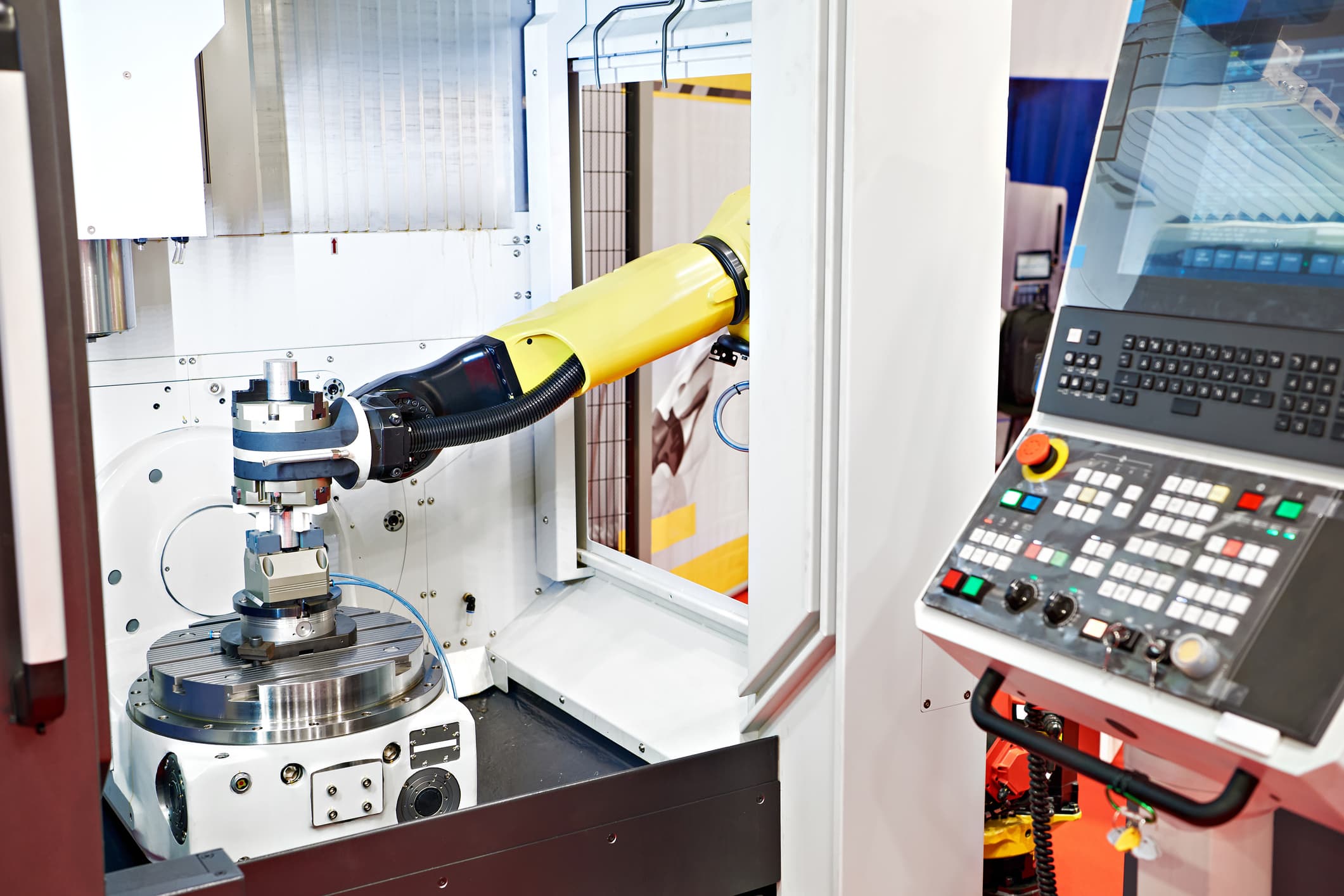
CNC machines typically lose more time between cycles than during them.
Assembly & Testing
Removing manual assembly and test steps minimizes variations and costly rework.
Quality Inspections
Dimensional drift gets noticed before downstream rejection.
Industrial controls
Disconnected CNC, PLC, HMI, and MES require manual coordination. Get fewer coordination errors and real‑time visibility into cell performance.
Flex Feeding & Bin Picking
Don’t depend on operators sorting high‑mix or unsorted parts. Get stable automated feeding and produce more parts per shift with the same headcount.
High‑Reliability Components
Tight tolerances and uptime outstrip manual processes. Get predictable volume at spec, with fewer field failures and returns.

Implementation Steps

We Turn Floor Data Into a Working System

We follow a simple sequence that positions your integration project for success. Each step is built around what is actually happening on your floor.

Evaluate
Map utilization, cycle times, part families, fixtures, operator workflow, and CNC machine behavior to find what slows output.
Design
Shape robotics, inspection, controls, and feeding around the work. Select automation type, reach, grippers, sequences, and data paths based on real cycle data.
Run
Commission, validate, and tune. Track utilization, unattended runtime, operator-to-machine ratio, FPY, and WIP. Operators run processes, not just load machines.

Results from the Floor

What the Numbers Look Like After Integration

CNC applications run for more hours with fewer interruptions. Operators cover more machines. Weekend capacity returns without added staffing. Quality stays stable because drift is caught earlier.

  • Spindle utilization: From 55% to 85%
  • Operator ratio: From 1:1 to 1:3
  • Weekend capacity: Recovered without adding staffing cost
  • First pass yield: Often above 98%

Industries

Unyielding standards meet unmatched precision and innovation. With a proven track record, we’re the trusted partner for industries that demand flawless results and refuse to settle for less than excellence.

photo of automotive parts that require cnc machining during some stage of manufacturing

Automotive

CNC machined components, tooling, and automation for high-performance automotive parts manufacturing with ISO-certified processes and advanced automation

Automotive
Oil pump jacks at sunset sky background

Energy Production

Custom parts and components for the energy production industry, designed for harsh environments

Energy Production
Close-up of Silicon Die being Extracted from Semiconductor Wafer and Attached to Substrate by Pick and Place Machine. Computer Chip Manufacturing at Fab. Semiconductor Packaging Process.

Electronics

Precision tooling and automation systems for the electronics manufacturing industry

Electronics
Military vehicles convoy

Defense

Military-grade components and assemblies for top-tier security and performance

Defense
A modern 3D printer printing a metal turbine in an example of metal additive manufacturing

Additive Manufacturing

Additive build plates, part separations, secondary machining, and automation solutions tailored to your needs

Additive Manufacturing
Empty Operation Room In Hospital

Medical

Custom tooling and robotic systems for medical device manufacturing

Medical
image of automation equipment producing industrial-products

Industrial Products

PMi2’s precision machining and advanced automation support the fabrication of industrial products that excel in quality and performance

Industrial Products

The Cost of Standing Still

Labor Pressure. Flat Output. Quality at Risk.

Labor pressure rises while output stays flat. CNC machines capable of long shifts run short days. Competitors automate and quote faster. Process knowledge leaves when machinists leave. Capital sits underused.

robotics, people and engineer tablet with industrial collaboration and planning in warehouse.

Take the Next Step

Not a proposal. An assessment.

We look at cycle times, part mix, layout, controls, and how the work actually moves. Let’s discuss what your integration looks like.

Contact Us